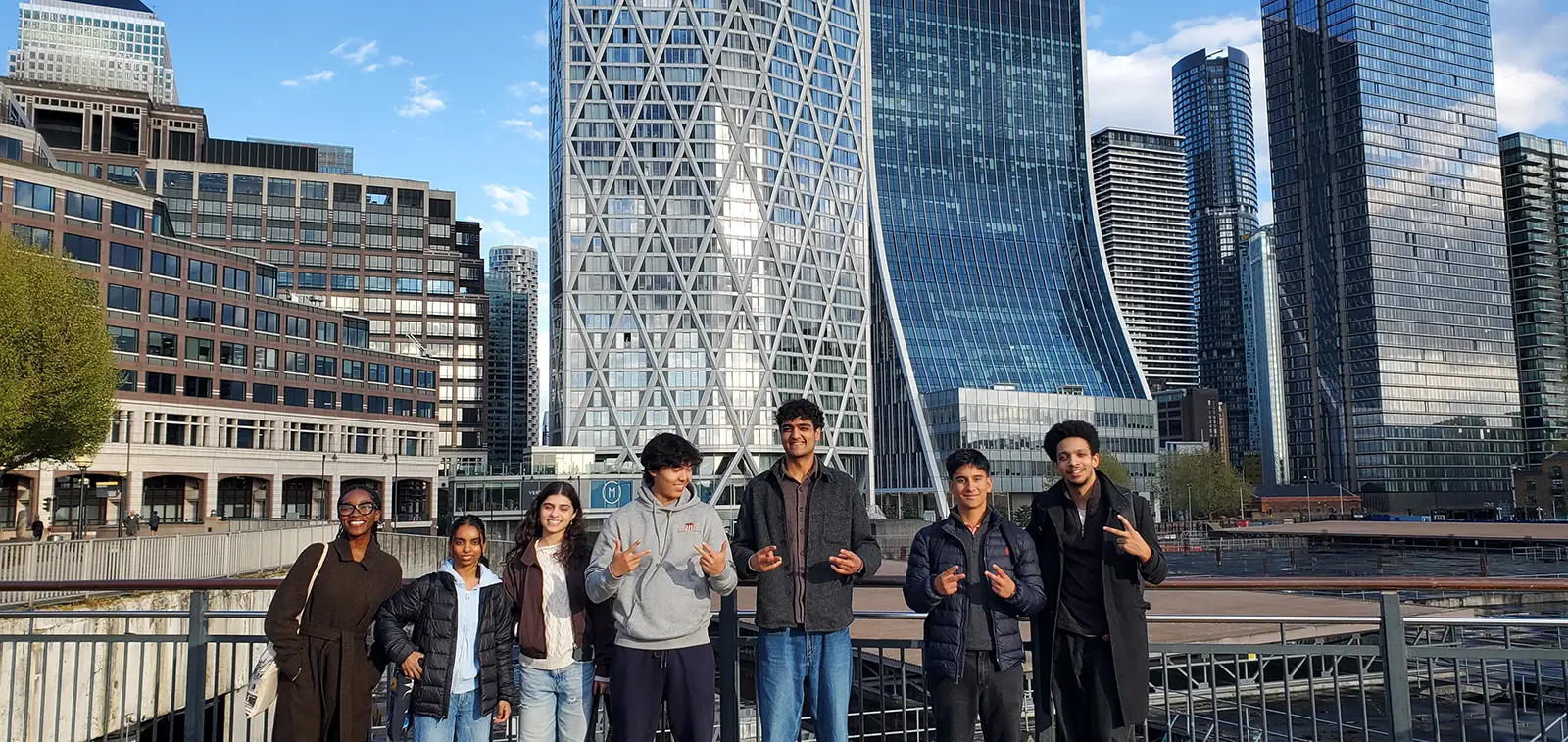
Canary Wharf walking tour
What was the site visit?
A walking tour of points of interest related to sustainable development in Canary Wharf.
What was involved?
Approximately six points of interest bearing on infrastructural, architectural, financial, industrial, and social aspects of the development of Canary Wharf since the 1980s. Historical information about the area spanning the early industrial period to the present day.


How did students learn?
In the class session prior to the site visit, we considered the Docklands as case study in urban regeneration. This session asked students to role play community members, private investors, and local and senior government officials with a stake in reviving the Docklands just at the turn of the 1980s, before the London Docklands Development Corporation displaced the preexisting Docklands Joint Committee and established a new agenda for reviving the area.
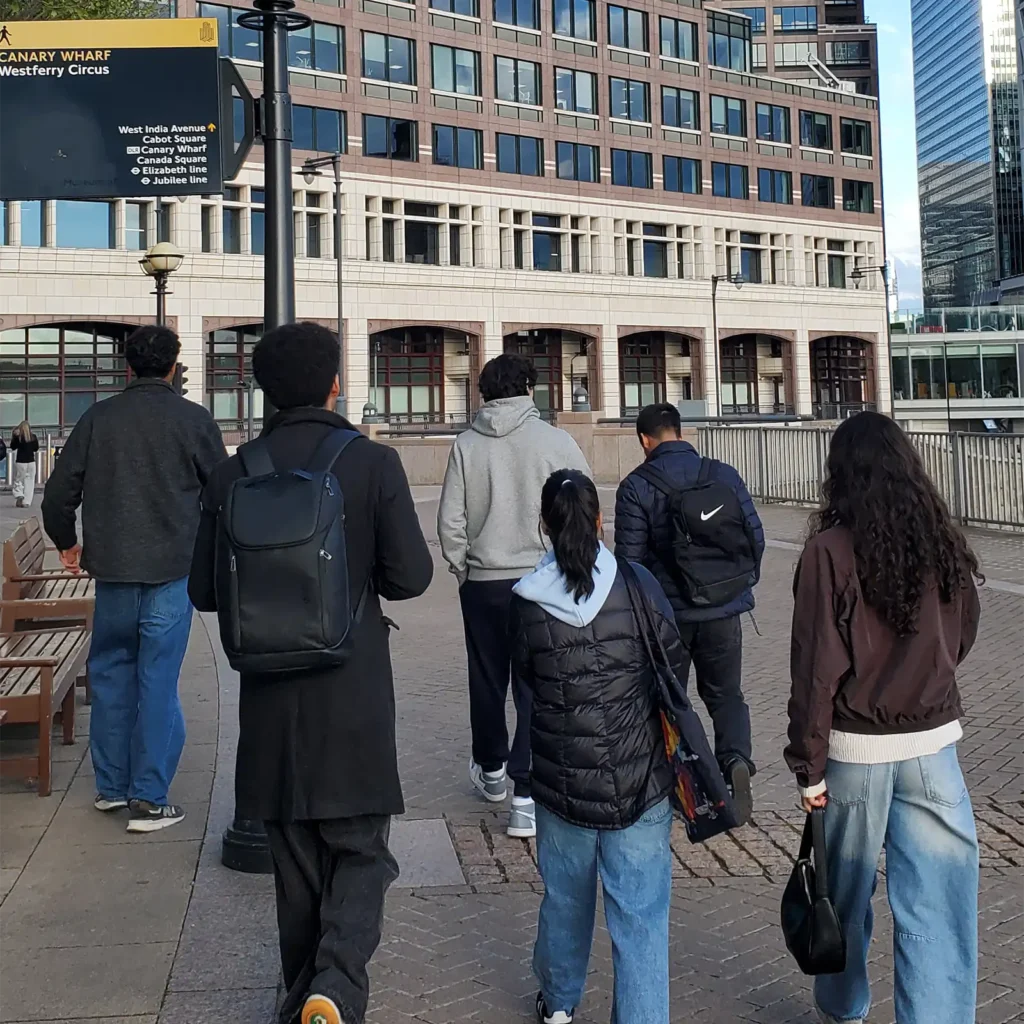
Canary Wharf figured at the center of that agenda as an extension of the London Square Mile, and we took to the Isle of Dogs to see firsthand how the area grew over the years and whether it deserves to be considered a case study in sustainable development, especially given pronounced local opposition to the shift from the industrial economy for which the area was known to the service economy that has prevailed since the 80s (students were assigned to watch BBC news footage contemporaneous with the proposal for the site). During the tour, we focused on different elements of Canary Wharf, and Docklands at large, as they were transformed – from transportation, to housing, to commerce, to industrial archaeology and income distribution.
Key benefits for students included:
- The ability to experience Canary Wharf on a typical late Monday afternoon – what people are around, and how many, what businesses are open, what buildings are used for, how the location feels in terms of scale, accessibility, energy, aesthetics, etc.
- Bringing history to life
- Personal relevance of financial sector points of interest (most students belong to DMSB)
Student perspective

“Candidly, I likely wouldn’t have made it over there before leaving London, so I’m very glad I got to explore a new part of the city while learning its history.”
Faculty perspective
“I would definitely do this again! During our debrief in the following class session, students drew links between Canary Wharf and Seaport in Boston, which I had not heard of before. I took it away as a homework assignment to explore whether some comparison/contrast might be developed with another local Northeastern landmark, in a different part of the globe!”

Northeastern University London is a charity
registered with the Charity Commission for
England and Wales (charity number 1189858).
Location
Devon House
58 St Katharine’s Way
London E1W 1LP, UK
+44 20 7637 4550
Northeastern University London is part of a global system, linking 14 campuses across the U.K., U.S., and Canada. Learn more about how our network serves as a platform for scaling ideas, talent, and solutions.
QUICK LINKS
Quick links
CAMPUS LOCATIONS