
Institute for Intelligent Networked Systems
Launched in January 2026, Northeastern University’s Institute for Intelligent Networked Systems (INSI) London hub is a transatlantic research centre focused on next-generation connectivity and intelligent computing and learning systems.
Researchers at Northeastern University London act as a bridge between the US and Europe, advancing interdisciplinary collaboration across continents in telecommunications, artificial intelligence, quantum information, information processing, and emerging hardware technologies.
Research areas
Intelligent computing and AI systems
We develop new approaches to machine learning and intelligent algorithms that can process complex information and adapt to changing environments. Our research bridges fundamental principles with real-world applications. We explore how AI systems can be designed to work more efficiently and reliably across different computing platforms.
Emerging hardware technologies
We research new hardware architectures and technologies that will enable more efficient and powerful computing systems. Our work includes neuromorphic computing (computing inspired by the human brain), novel semiconductor technologies, and specialised processors designed for AI and machine learning. We explore how hardware and software can work together more effectively to meet the demands of intelligent networked systems.
Next-generation connectivity and telecommunications
Our research explores the infrastructure and systems that will shape future communication networks. As demand grows for faster and more reliable data transmission, we investigate advanced network architectures and connectivity solutions. Our work develops the foundational technologies needed to enable seamless global connectivity in an increasingly interconnected world.
Quantum information and information processing
Quantum computing and quantum communication represent a fundamental shift in how information can be processed and transmitted. Our work in this area focuses on quantum algorithms, error correction methods, and networking protocols. By examining both the underlying science and engineering requirements, we aim to advance quantum technologies that could transform computation and secure communication.
Our team in London
Faculty


Researchers
-
 Rashi Dutt Research FellowRead full bio
 -
 Amirmohammad Farzaneh Research Associate in Intelligent Networked Systems InstituteRead full bio
 -
 Jiayi Huang Visiting ResearcherRead full bio
 -
Stefan Johannesson Visiting researcher at the Intelligent Networked Systems InstituteRead full bio
-
Prabodh Katti Visiting Researcher at the Intelligent Networked Systems InstituteRead full bio
-
 Tom Kuipers ResearcherRead full bio
 -
Tengteng Lei Visiting Researcher at the Intelligent Networked Systems InstituteRead full bio
-
Tanqiu Qiao Research Associate in Analogue AI AcceleratorsRead full bio
-
Clement Ruah Research Associate at the Institute for Intelligent Networked SystemsRead full bio
-
Houssem Sifaou Research Fellow at the Institute for Intelligent Networked SystemsRead full bio
-
Pietro Talli Postdoctoral Research Associate in Reliable AI for EngineeringRead full bio
-
 Abin Varghese Visiting Researcher at the Intelligent Networked Systems InstituteRead full bio
 -
Bowen Wang PhD Researcher in Intelligent Networked Systems InstituteRead full bio
-
Dengyu Wu Visiting Researcher at the Intelligent Networked Systems InstituteRead full bio
-
Seunghun Yu Visiting ResearcherRead full bio
-
Meiyi Zhu PhD Researcher in Intelligent Networked SystemsRead full bio
















News
-

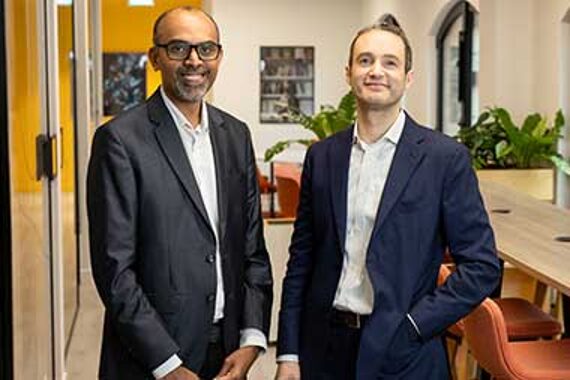
Northeastern University’s Institute for Intelligent Networked Systems opens a new hub in London after its success in Boston and Burlington. Their projects focus on optimising wireless communications, with a focus on AI.
-

Osvaldo Simeone published a book on Classical and Quantum Information Theory on Cambridge University Press. The text can be used for senior undergraduate and graduate students in electrical engineering, computer science, and applied mathematics, looking to master the essentials of information theory.

Projects
Engineering Networked Machine Learning via Meta-Free Energy Minimisation
FreeML: Engineering Networked Machine Learning via Meta-Free Energy Minimisation
PI: Simeone
Sponsor: Engineering and Physical Sciences Research Council
Inspired by neuroscience, informed by information-theoretic principles, and motivated by modern wireless systems architectures integrating artificial intelligence (AI) and communications, this Fellowship sets out to develop a paradigm-shifting framework for networked machine learning (ML) that is centred on free energy minimisation, networked meta-learning, and native integration of wireless communication and learning.

Brain-Inspired Wireless Communications
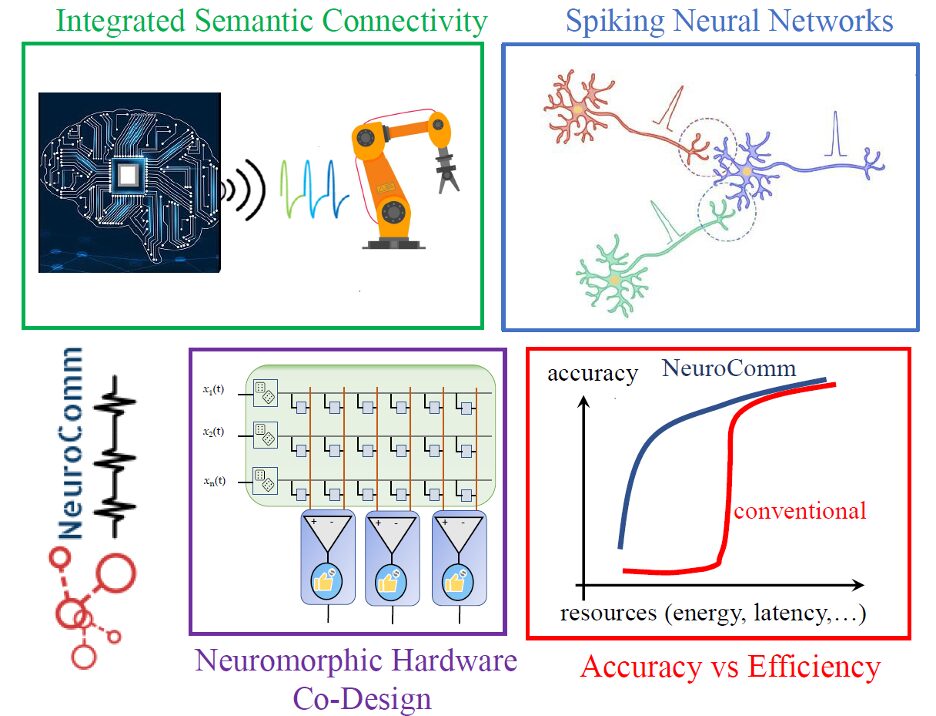
NeuroComm: Brain-Inspired Wireless Communications – From Theoretical Foundations to Implementation for 6G and Beyond
PIs: Simeone and Rajendran
Sponsor: Engineering and Physical Sciences Research Council & US National Science Foundation
This project explores integrated neuromorphic sensing and computing which is emerging as alternative, brain-inspired, paradigms for efficient data collection and semantic signal processing that build on event-driven measurements, in-memory computing, spike-based information processing, reduced precision and increased stochasticity, and adaptability via learning in hardware.
Conformal Calibration for Reliable AI-Based Wireless Communications
CONTRACT: Conformal Calibration for Reliable AI-Based Wireless Communications
PI: Simeone
Sponsor: European Research Council
CONTRACT sets out to investigate a novel, theoretically principled, framework for the reliable
deployment of artificial intelligence (AI)-based black-box models in wireless systems.
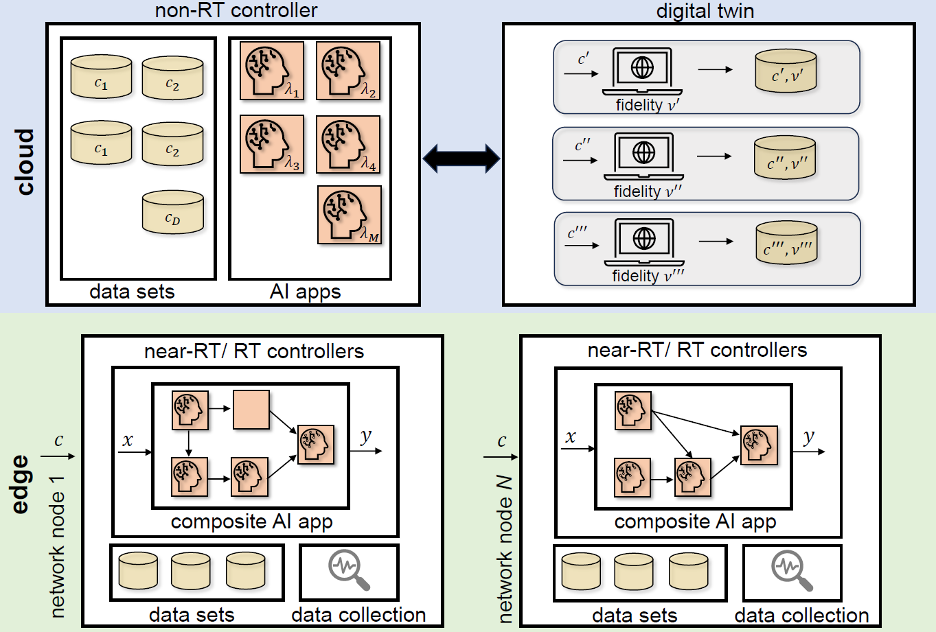
Given the highly non-deterministic patterns of traffic and connectivity conditions, AI is currently viewed as an essential technology to ensure the support of communication services with widely heterogeneous performance requirements, ranging from cloud gaming to Industry 4.0.
However, AI “apps” are, by and large, black boxes, whose introduction within the larger wireless network raises critical concerns about reliability.
The main goal of CONTRACT is to endow for the first time AI-based wireless deployments with formal reliability guarantees.
To this end, CONTRACT will introduce novel methodologies for: (i) the offline calibration of pre-trained AI apps via hyperparameter optimization prior to deployment; and (ii) the online run-time monitoring of key performance indicators and conflicts among simultaneously deployed apps. In CONTRACT, hyperparameter optimization and online monitoring will leverage contextual information describing traffic and connectivity conditions, as well as synthetic data from a digital twin, i.e., a simulator, of the wireless network.
Verifiably Robust Conformal Probes
Verifiably Robust Conformal Probes
PIs: Nicola Paoletti (King’s College London), Simeone
This project develops ways of detecting misaligned LLM behaviours with a high degree of confidence, attaching a quantitative value to that level of trust. The goal is to enable safer and more socially beneficial models and empower policy makers to make better decisions about any necessary guardrails on the technology.

Smart and Green AI
SGAI: Smart and Green AI
PI: Rajendran
Sponsor: Engineering and Physical Sciences Research Council
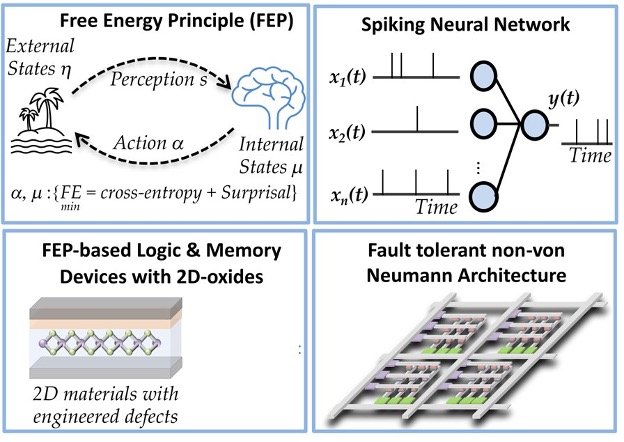
This EPSRC fellowship will lay the foundations for a new AI paradigm featuring algorithms based on the free energy principle (FEP) and hardware platforms leveraging the stochasticity of novel nanoscale devices based on 2-dimensional materials, enabling embedded systems with unprecedented efficiency.
Multiprocessor system with in-memory neural processing unit
NeuroSoC: A multiprocessor system on chip with in-memory neural processing unit
PI: Rajendran
Sponsor: Horizon Europe & InnovateUK
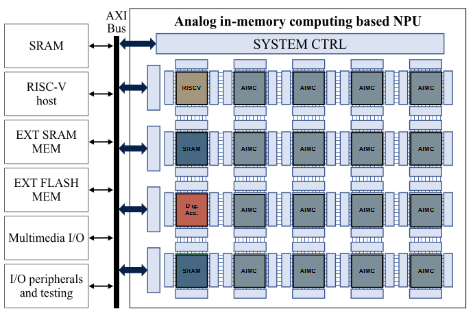
The overarching objective of NeuroSoC is to develop a flexible computing system where an analogue in memory computing (IMC)-based neural processing unit is integrated into a multi-processor functional safe and secure system-on-chip to tackle the requirements of a wide set of edge-AI applications.
Neuromorphic Accelerators for Learning and Inference with LLMs
NeuMatmul: Neuromorphic Accelerators for Learning and Inference with LLMs
PI: Rajendran
Sponsor: ARIA
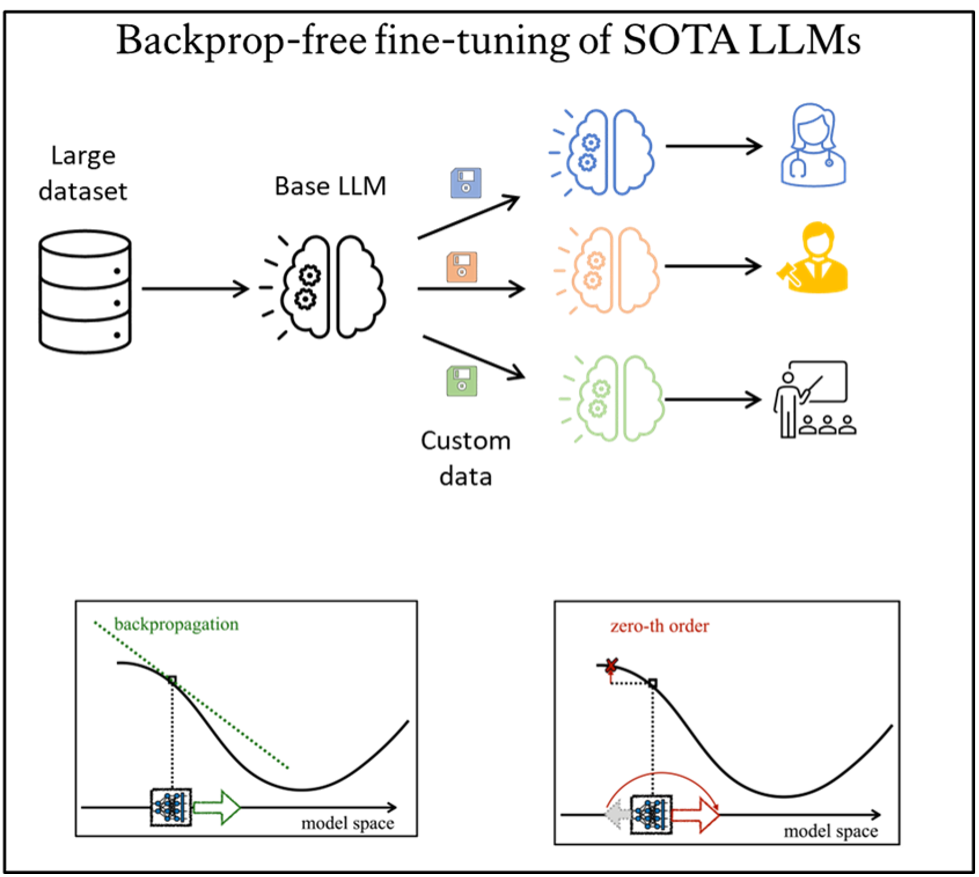
The project will develop brain-inspired algorithms and hardware accelerators for fine-tuning large language models, avoiding the energy-intensive backpropagation methods used in current AI training.
By combining these biological learning principles with in-memory computing hardware, the team aims to significantly reduce the energy and time required to train and adapt AI models.

Northeastern University London is a charity
registered with the Charity Commission for
England and Wales (charity number 1189858).
Location
Devon House
58 St Katharine’s Way
London E1W 1LP, UK
+44 20 7637 4550
Northeastern University London is part of a global system, linking 14 campuses across the U.K., U.S., and Canada. Learn more about how our network serves as a platform for scaling ideas, talent, and solutions.
QUICK LINKS
Quick links
CAMPUS LOCATIONS