
Student Visit to St Bride Foundation
What were the site visits?
A guided workshop and historical tour of the St Bride Foundation in London, a premier archive for printing and typography. Established in 1891 near Fleet Street–the traditional heart of the British press–the Foundation served as a social and educational hub for the printing industry.
It houses one of the world’s most significant collections of typefounders’ specimens, historical presses, and typographic artifacts, marking it as a vital repository of London’s industrial and cultural heritage. The visit focused on the evolution of visual communication, from the Gutenberg Bible and the emergence of movable type to the industrialization of the London newspaper trade.
What was involved?
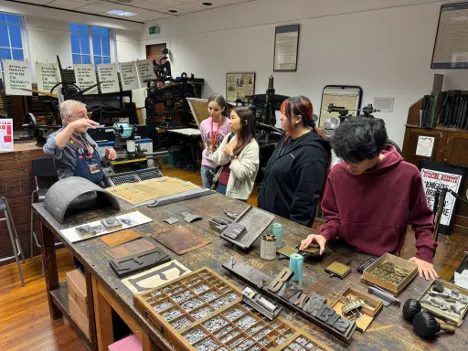
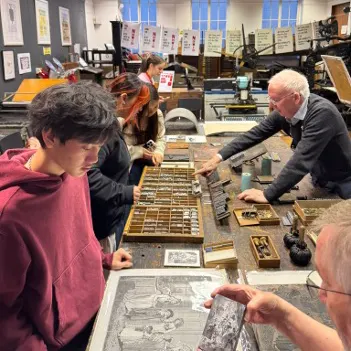
The session included an immersive workshop led by technical experts. Students engaged with:
- Historical archives: examining rare specimens of early printed works.
- Technological evolution: tracing the development of printing prototypes and the mechanics of the hand press.
- Physical type: a hands-on introduction to movable type, including the terminology and spatial logic of letterpress composition.
How did students learn?
Learning was achieved through object-based inquiry and kinaesthetic engagement. By physically handling type and observing the mechanics of historical presses, students bridged the gap between abstract digital design and its tactile, industrial origins. This experiential approach allowed non-design majors to grasp complex typographic systems through the “logic of the hand.”
Key benefits for students included:
- Contextual understanding: gaining a historical framework for modern typographic systems, seeing how technical constraints of the past shaped current digital standards.
- Interdisciplinary insight: Understanding the intersection of technology, literacy, and commerce in London’s history, making the material accessible regardless of the student’s primary major.
- Systems thinking: recognizing typography not just as an aesthetic choice, but as a rigid, grid-based physical system that requires precision, spatial planning, and an understanding of “negative space.”
Student perspective

“It was a great experience to walk through the history of typography in London, in England. Nice experience to see all the machines and components that form periods of this history.”
“It was very informative and insightful to learn the history of printmaking in London. It’s gave me a newfound appreciation of where we are today with articles and written text. The evolution of physical printmaking to digital print is a result of human ingenuity, and it surprised me to see how efficient and intelligent the people who made and created the machines like the monotype, which helped print and create blocks of texts for newspapers quickly.”
Faculty perspective

“For today’s design students, who often work in digital environments, understanding the analogue processes that shaped visual communication is not simply an exercise in nostalgia. It is a means of developing a richer, more considered design sensibility. Seeing and handling the physical artefacts of print history brings a depth of understanding that no screen-based resource can replicate. Visits like this are a vital part of how we prepare students to think critically and creatively about their practice.”

“Our visit to the St Bride Foundation offered students a rare, hands-on immersion into the epicentre of printing history and typography. By engaging with one of the world’s most significant graphic arts collections, students bridged the gap between historical craftsmanship and modern design, gaining a profound appreciation for the physical origins of the digital tools they use today.”
Northeastern University London is a charity
registered with the Charity Commission for
England and Wales (charity number 1189858).
Location
Devon House
58 St Katharine’s Way
London E1W 1LP, UK
+44 20 7637 4550
Northeastern University London is part of a global system, linking 14 campuses across the U.K., U.S., and Canada. Learn more about how our network serves as a platform for scaling ideas, talent, and solutions.
QUICK LINKS
Quick links
CAMPUS LOCATIONS