
Widening Participation

What is widening participation?
Widening participation (WP) is about making sure that university is accessible to everyone, regardless of their background. Across the UK, some groups of students are less likely to go to university – not because of their ability, but because of the barriers they face.
These barriers might be financial, social, or related to a lack of support and information about higher education. At Northeastern University London, we are committed to identifying and supporting students from underrepresented backgrounds – whether you’re exploring your options, attending one of our events, applying to study with us, or already on your degree.
What support is available?
Students who meet our widening participation criteria may be eligible for a range of support, including:
- Student Success Fund: direct financial support for eligible students throughout their degree
- Northeastern University London Bursary: income-assessed financial support of up to £5,000 per year
- Travel support: funding to help with travel costs for campus visits and university events.
- Contextual admissions: we consider your achievements in the context of your background and circumstances
- Outreach programmes: including our Get Ahead Summer School, Get Ahead: Uni Unlocked webinars, and other opportunities.
Further information and links can be found below.
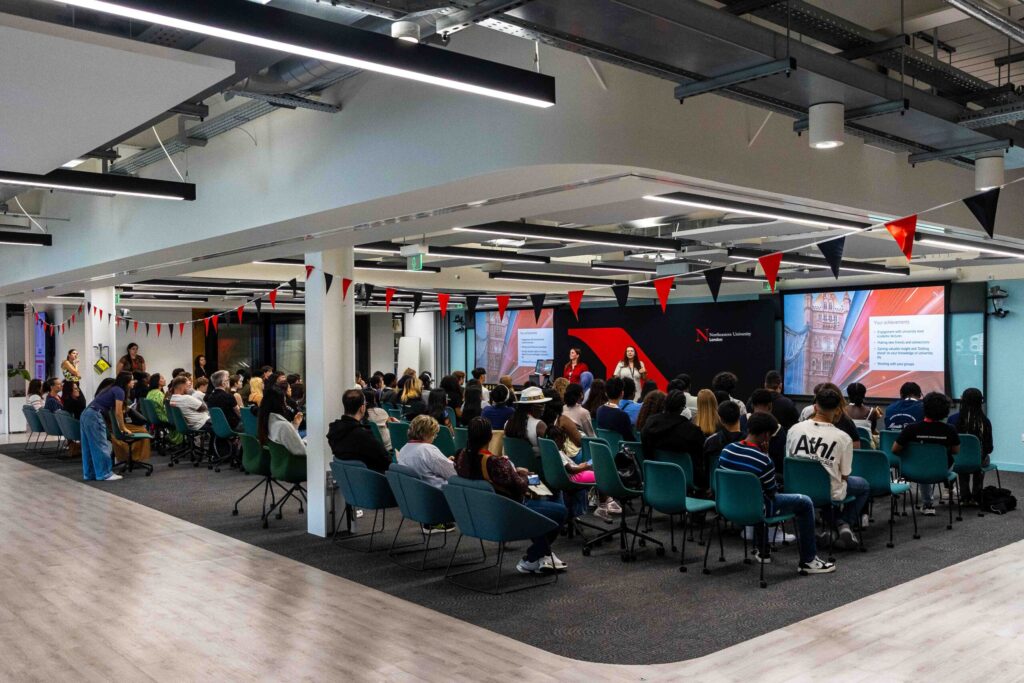
Our widening participation criteria
We use the following criteria to identify students and prospective students who may benefit from additional support and opportunities. You may meet one or more of these criteria.
Care experienced
Students who have spent time living with foster carers under local authority care, in residential care (such as a children’s home), looked after at home under a supervision order, or in kinship care with relatives or friends – whether officially (such as under a special guardianship order) or informally without local authority support.
Estranged students
Students under the age of 25 who are estranged from their parents or guardians and are therefore independent.
Young adult carers
Students who, at the point of application, were under the age of 20 and whose life was adversely affected by caring for a family member who has a chronic illness, disability, mental health condition, or addiction.
Forced migrants
Students who are classified as a refugee, asylum seeker, or who have been granted a temporary form of leave as the result of an asylum or human rights application.
Free School Meals (FSM)
Students who are or were in receipt of Free School Meals during their secondary school studies.
Widening participation school
Students who attended a state school, a school with a higher than average percentage of students on Free School Meals, or a low-performing school. This can include both GCSE and A-level performance measures.
Underrepresented postcodes
We use two national measures to identify students from areas where participation in higher education is lower than expected:
- POLAR (Participation of Local Areas): Based on the proportion of the young population that participates in higher education. We focus on students from areas in the two lowest participation quintiles (Quintile 1 and 2).
- IMD (Index of Multiple Deprivation): Analyses a postcode taking into consideration income, employment, health deprivation and disability, education, skills and training, barriers to housing and services, crime, and living environment. We focus on students from postcodes in the most deprived quintile (Quintile 1).
How do we identify widening participation students?
If you’re applying to study with us, we use the information you provide on your UCAS or direct application form to assess whether you meet any of our widening participation criteria. We encourage you to share as much information as possible on your application so that we can identify the support available to you.
If you’re attending one of our outreach events or programmes, such as our Get Ahead Summer School or campus visits, we may ask you to share some background information so we can tailor our support to you.
You don’t need to apply separately for widening participation status – if you’re eligible, our widening participation team will be in touch to let you know about the support and opportunities available to you.
If you think you may be eligible but didn’t include this information on your application, or if your circumstances have changed, please contact our widening participation team at wp.team@nulondon.ac.uk.
Find out more
Please find below details of Northeastern University London’s Widening Access and Participation initiatives.

Questions?
If you’d like to know more about widening participation at Northeastern University London, please contact the widening participation team.

Northeastern University London is a charity
registered with the Charity Commission for
England and Wales (charity number 1189858).
Location
Devon House
58 St Katharine’s Way
London E1W 1LP, UK
+44 20 7637 4550
Northeastern University London is part of a global system, linking 14 campuses across the U.K., U.S., and Canada. Learn more about how our network serves as a platform for scaling ideas, talent, and solutions.
QUICK LINKS
Quick links
CAMPUS LOCATIONS