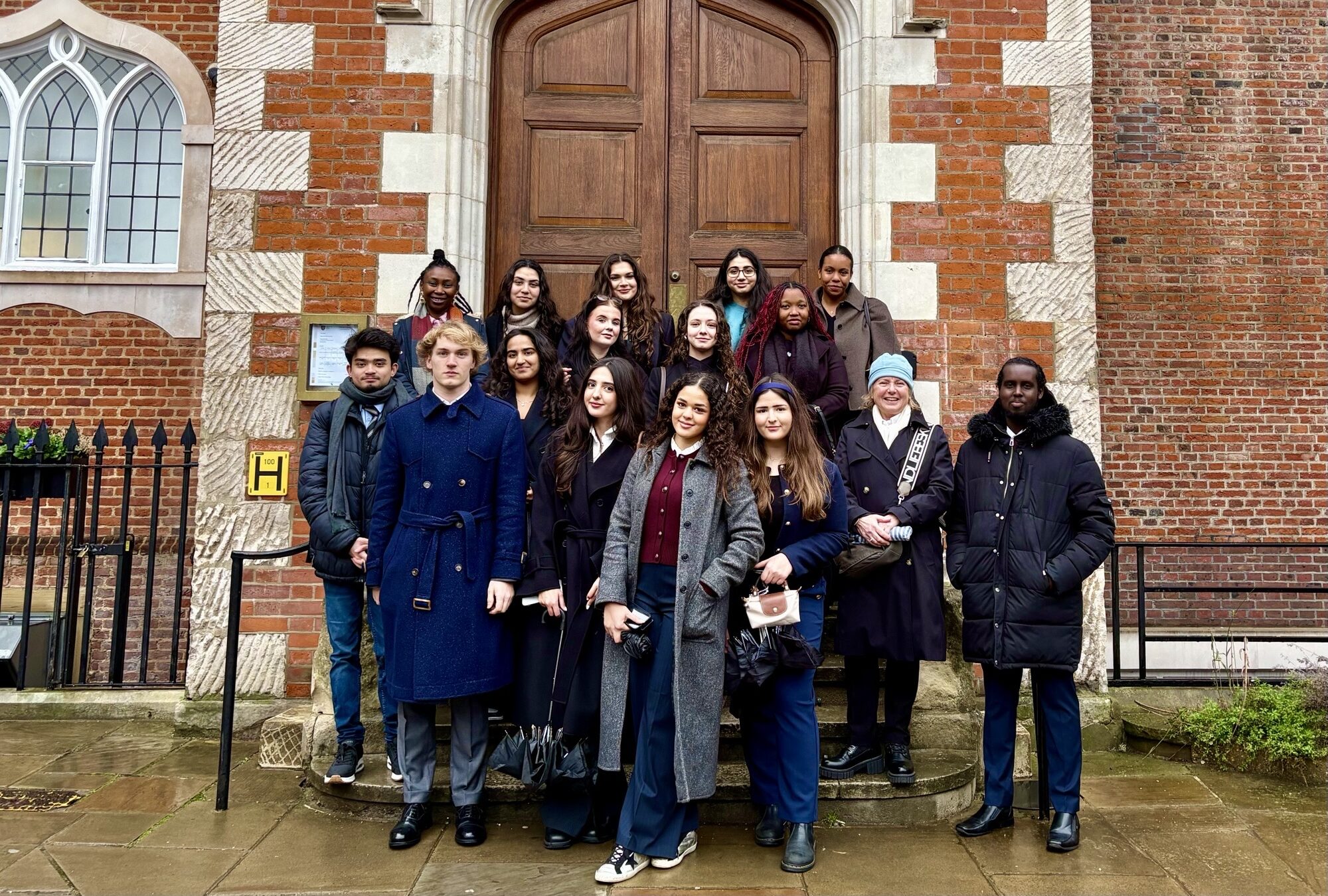
A visit to Gray’s Inn
A visit by Northeastern University London law students to Gray’s Inn
By Ursula Smartt, Associate Professor of Law and Legal Careers Counsellor at Northeastern’s London campus.
“Do as adversaries do in law, strive mightily, but eat and drink as friends.”
William Shakespear – Taming of the Shrew, Act I, sc. 2 (1592).
Some 17 law students from the London campus, accompanied by Mr Dewale Ola Dimeji, from the careers service, and Dr Fayokemi Olorundami, head of the law discipline, visited one of the four inns of court on 21 January 2021. Ursula Smartt, Associate Professor of Law, in charge of the Legal Careers Service at NU London, had organised the visit jointly with Gray’s Inn educational outreach service.
Ursula takes a group of new law students – or those second and third year students who wish to gain further insight into a legal career as a barrister – to one of the four inns: Middle and Inner Temple, Gray’s and Lincoln’s Inn. This is where barristers train, whilst they undertake the study of the bar professional course and practise ‘pupillage’ with their sets of chambers.
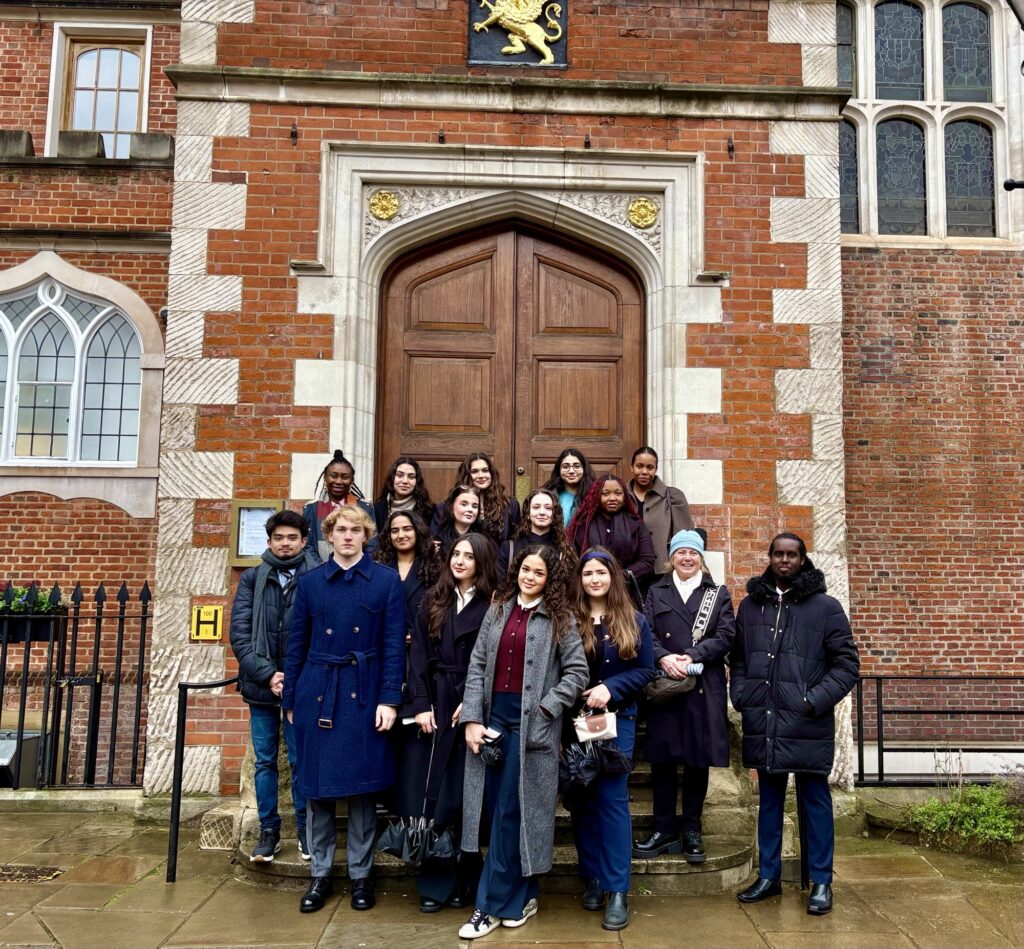
Gray’s Inn dates back to the mid-16th century, whilst some of the other inns are as old as the mid-fourteenth century, where lawyers began to congregate and practise law. ‘Temple’ underground station in the City of London, occupies several hundred acres with magnificent buildings, and some lodgings for pupils (Gray’s and Lincoln’s). The magnificent Temple Church adjacent to Middle and Inner Temple was erected by the Knights Templar and subsequently acquired but not used by the Knights Hospitaller (therefore the name ‘inn’).
Lincoln’s Inn to the west of Chancery Lane, on land partly owned by the Bishops of Chichester, and Gray’s Inn to the north-east, on a site formerly occupied by the Lords Grey of Wilton as their London residence provide accommodation for trainee barristers to this very day. In the early modern period, the inns of court became collectively known as ‘the third university of England’.
As part of barristers’ training it is a requirement to take part in a number of dinners at each inn’s great hall. NU London law students and staff had a magnificent lunch at Gray’s Inn Great Hall. Barristers who eventually qualify and obtain full pupillage at chambers may call themselves ‘qualified barrister’ and must be formally called to the bar. ‘Called to the Bar’ is the formal ceremony and process by which a qualified law student is admitted as barrister in common law jurisdictions, granting them the right to argue cases in higher courts.
They will wear formal dress and a wig. ‘The bar’ refers to the physical wooden barrier or railing in traditional courtrooms that separated the public from the area reserved for judges and advocates. This can be seen in the Court of Appeal Criminal Division in the Royal Courts of Justice, Strand, London. Only a qualified barrister can appear before the King’s superior courts, such as Crown Court (criminal); the High Court King’s Bench Division (incl. court of chancery and family); the court of appeal (criminal and civil divisions) and the UK Supreme Court. Solicitors can appear before lower courts, such as magistrates (criminal) and county courts (civil).
In recent times, the inns have formed and contributed to a number of joint bodies to promote, educate, regulate and discipline the profession, such as the Council of the Inns of Court and the Bar Council (or General Council of the Bar). The inns of court have never been incorporated and exist today as associations, regulated by custom and standing order.
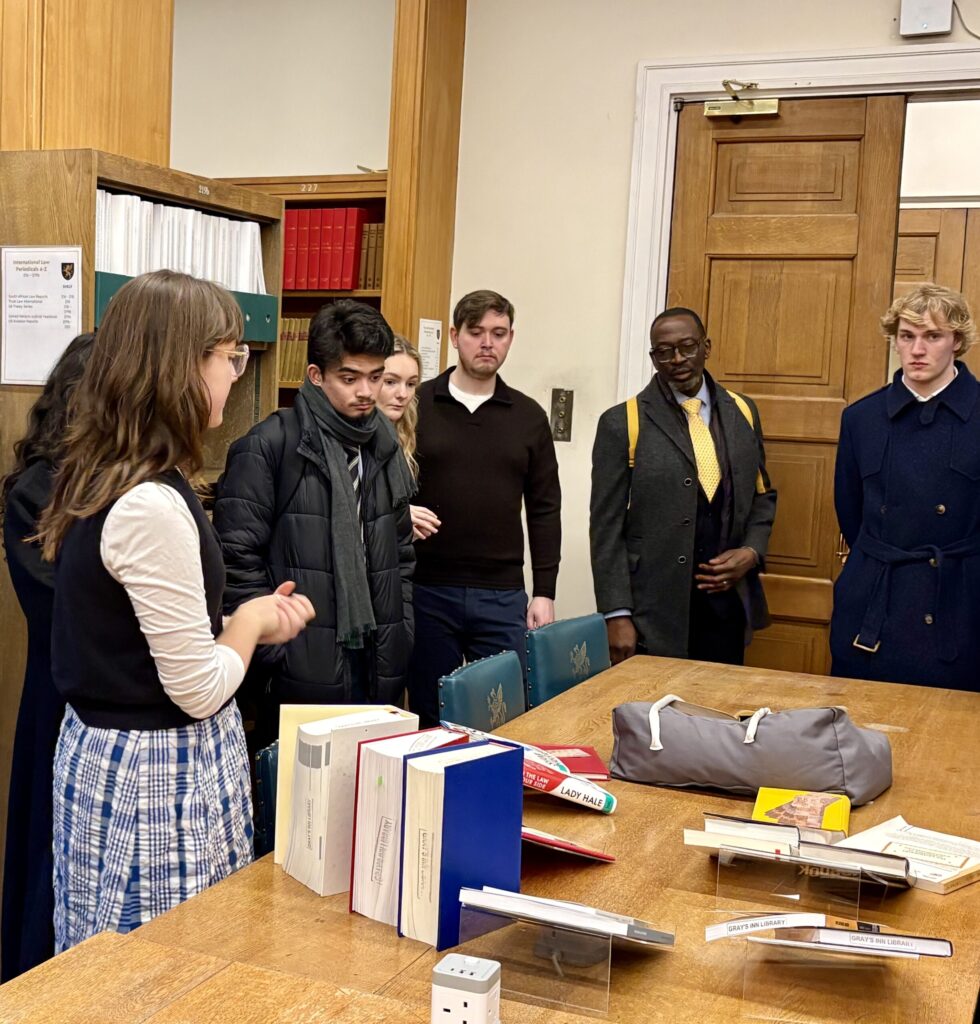
After lunch the law students visited the library and were shown real law reports on the shelves which contain annual copies of each court of record’s proceedings, such as the All England Law Reports; the Weekly Law Reports, the UK Supreme Court reports etc. Nowadays, all law reports are found online via two platforms, Lexis and Westlaw. Each law student enrolled on the English law degree (Bachelor of Laws – LLB) receives training during their first week of legal study at the London campus.
The students were informed about membership of the inn, and categories of membership, namely: students, barristers and benchers. Benchers are elected by the inn, having attained either the highest office of King’s Counsel (KC) or judicial office, on the basis of a distinguished professional career. It is one of the most senior benchers who becomes Treasurer of the inn for the year.
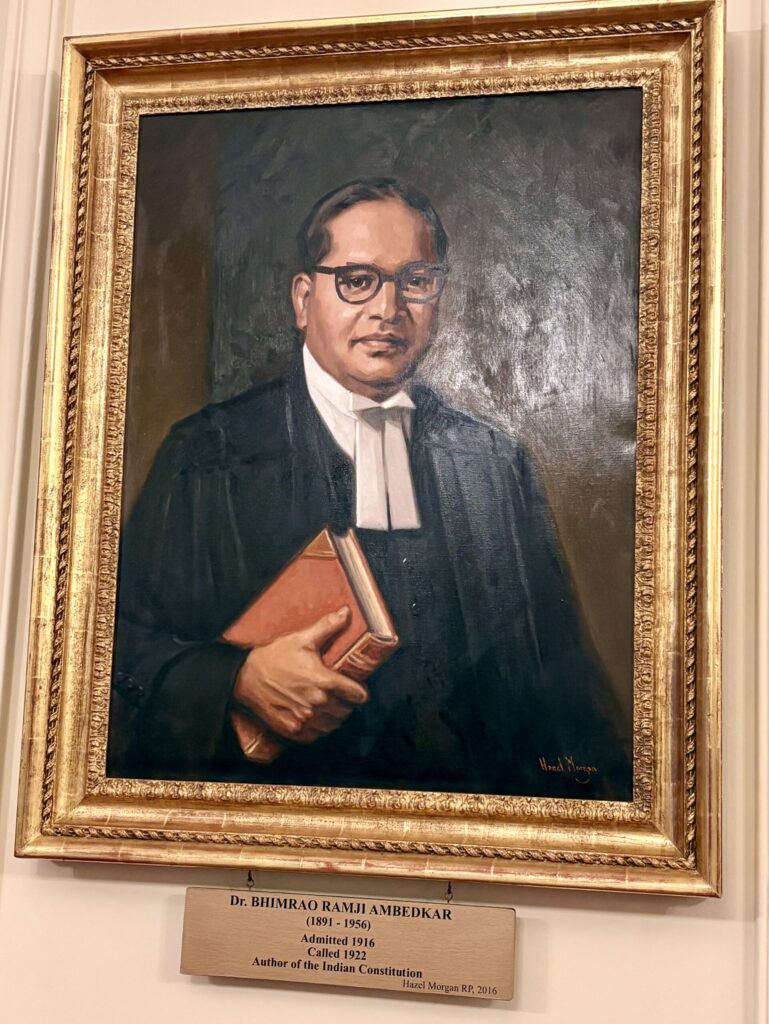
As is the case with most long-lived institutions, the walls of the Great Hall and the various rooms visited by law students, showed a number of miscellaneous pictures, photographs, shields and family crests, depicting judges which had been read in their law reports , such as Lord Bingham and Lady Hale. Gray’s Inn librarian told the students that the inn had acquired its own collections of manuscripts and books, dating back to the 16th and 17th centuries.
It is fair to say that most law students graduating with the English LLB will go on to practise as solicitors, for which they have to take the two-part Solicitors Qualifying Examination (SQE). Very few will go on to seek a career as and practise as barristers in England and Wales. In 2025 there were approximately 17,600 practising barristers in England and Wales. As a percentage of the overall population of England and Wales, this number is very small, roughly 0.03% of the roughly 60 million population.
The law students were told that they must join one of the four inns of court in London and should be recorded in the relevant admissions register. Students from the British Commonwealth and overseas territories also come to London to train as barristers in order to return to their own countries to practise. Each inn has a significant contingent of Commonwealth students and qualified barristers, mainly from India and Africa. European students are welcome, as long as they indicate when applying for a scholarship at the inn, that they intend to practise in England/ Wales (there are separate qualifications needed for advocates in Scotland and Northern Ireland).
To complete their training, barristers have to serve a pupillage in an established set of chambers and then become accepted by that or another set of chambers, in London or in the provinces, such as Leeds, Manchester, Birmingham or Bristol, in order to practice and be called to the bar. Until the passing of the Sex Disqualification (Removal) Act of 1919, no women were admitted to any of the inns of court and even after 1922, when Ivy Williams, the first female barrister, was called to the Bar of the Inner Temple. Today women make up about 40% of the practising Bar and roughly 18% of the Bar are from a minority ethnic background.
In spite the fact that becoming a barrister is a demanding and all-consuming profession, four female and one male NU London law students expressed the wish to seek a career at the bar. The London Legal Careers Service at Northeastern supports students at every step, including nominating two students each year to every of the four inns for a bar scholarship. Jenna Hutton won her scholarship to Lincoln’s Inn in 2025 and graduated with a first class honours LLB in the same year.